
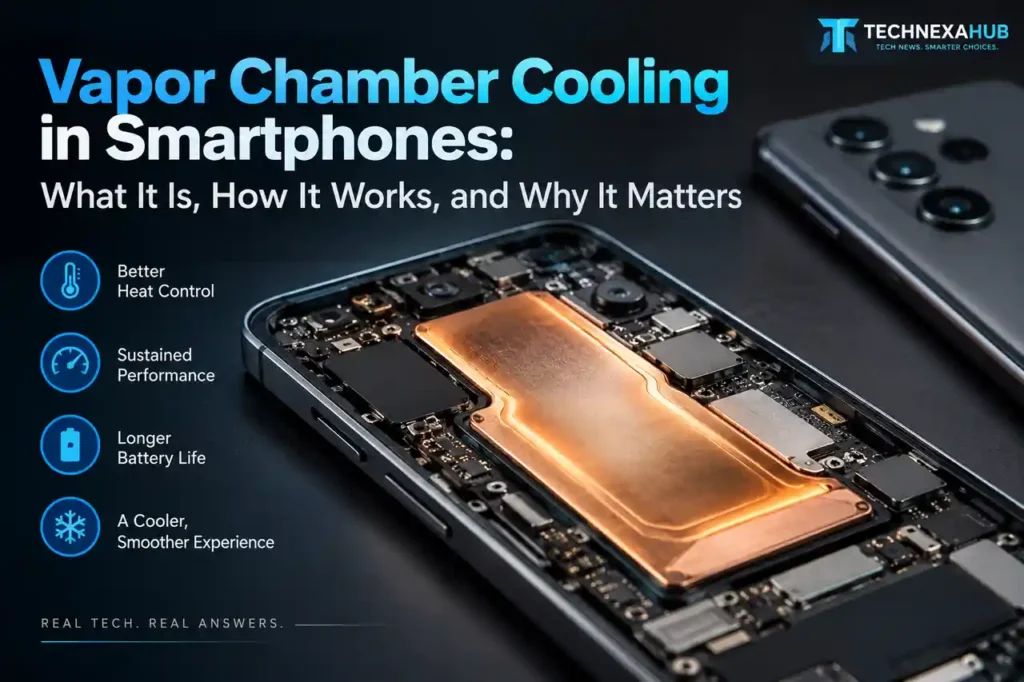
A vapor chamber is a thin, sealed heat-transfer component inside a smartphone.
It contains a small amount of working fluid and a wick structure. When the processor heats one section of the chamber, the fluid absorbs energy and turns into vapor.
That vapor moves toward cooler areas, where it condenses back into liquid. The wick then helps return the liquid toward the hot area.
Quick Answer
Vapor chamber cooling in smartphones is a passive thermal system that uses evaporation and condensation to move processor heat away from a concentrated hotspot and distribute it across a larger area.
It does not make the heat disappear. Instead, it makes the heat easier for the phone’s overall thermal system to manage.
How Does Vapor Chamber Cooling Work?
The basic cycle is straightforward:
| Step | What happens |
|---|---|
| 1. Heat generation | The CPU or GPU produces heat during gaming, AI processing, video recording, and other demanding workloads. |
| 2. Evaporation | The working fluid near the hot area absorbs heat and becomes vapor. |
| 3. Vapor movement | The vapor travels through the chamber toward cooler regions. |
| 4. Condensation | The vapor releases heat and turns back into liquid. |
| 5. Liquid return | The internal wick draws the liquid back toward the heat source through capillary action. |
The cycle can continue while the phone is under a sustained thermal load.
Why Does a Vapor Chamber Need a Wick?
The wick is what helps circulate the working fluid inside the sealed chamber.
After the vapor condenses, the wick provides a pathway for the liquid to return toward the hotter part of the chamber.
Because the fluid moves through capillary action, the system does not need a conventional mechanical pump.
That is one reason phone vapor chamber cooling works well inside thin devices.
What Does a Vapor Chamber Do in a Phone?
Its main job is heat spreading.
A processor can create a very concentrated hotspot. If the heat stays around that small area, temperatures can rise quickly and the phone may eventually reduce performance to stay within its thermal limits.
A vapor chamber helps distribute that heat across a wider area.
That can support:
- More consistent performance during long workloads
- Better heat distribution
- Sustained gaming
- Extended video recording
- Demanding AI processing
- Video editing and other intensive applications
The key point is simple: a vapor chamber moves heat; it does not eliminate heat.
The phone still needs its frame, chassis, thermal interfaces, and other components to transfer that heat toward the outside environment.
Why Do Smartphones Use Vapor Chamber Cooling?
Smartphone processors are becoming increasingly powerful while phone bodies remain compact.
Gaming, AI, high-resolution video, camera processing, and other demanding tasks can keep the CPU and GPU busy for extended periods.
A large desktop can use fans, heatsinks, and other cooling hardware. A thin smartphone has far less room.
A vapor chamber provides a compact way to spread heat without requiring a conventional fan.
That makes it particularly useful for sustained performance, rather than simply producing a high benchmark score for a few seconds.
Vapor Chamber vs. Heat Pipe
Vapor chambers and heat pipes use related phase-change principles, but their physical layouts are different.
| Feature | Vapor Chamber | Heat Pipe |
|---|---|---|
| Typical shape | Broad and flat | Usually tubular |
| Heat movement | Spreads heat across an area | Transfers heat primarily along a path |
| Best use | Wide, compact thermal spreading | Point-to-point heat transfer |
| Thin-device suitability | Well suited to flat internal layouts | Depends on the available space |
| Smartphone use | Common in advanced thermal designs | Also used in electronics |
A vapor chamber is sometimes described as a flat heat pipe, but that is a simplified comparison. Their internal geometry and heat-flow patterns are not identical.
Does the iPhone 17 Pro Have a Vapor Chamber?
Yes.
Apple confirms that the iPhone 17 Pro and iPhone 17 Pro Max use an Apple-designed vapor chamber integrated into their aluminum unibody.
Apple says deionized water is sealed inside the chamber, which is laser-welded into the aluminum chassis. The system moves heat away from the A19 Pro chip and distributes it through the aluminum structure.
Apple also says that A19 Pro, when paired with the vapor chamber, enables up to 40% better sustained performance than the previous generation under Apple’s stated testing conditions. Apple specifically connects this thermal design with demanding activities such as gaming, video editing, and running large local language models.
This makes iPhone 17 Pro vapor chamber cooling an important part of the phone’s thermal architecture.
Does the Regular iPhone 17 Have a Vapor Chamber?
Apple’s cited documentation specifically identifies the vapor chamber as a feature of the iPhone 17 Pro and iPhone 17 Pro Max.
For that reason, the base iPhone 17 should not automatically be described as having the same vapor chamber system.
This distinction is important when discussing phrases such as iPhone 17 vapor chamber, does iPhone 17 have vapor chamber, or iPhone 17 vapor cooling.
For a closer look at the differences, compare the iPhone 17 vs iPhone 17 Pro including performance, cooling, gaming, battery life, cameras, and everyday use.
Does Samsung Use Vapor Chamber Cooling?
Yes.
Samsung uses vapor chamber technology in its high-performance Galaxy devices.
For the Galaxy S25 series, Samsung says its redesigned heat-dissipation structure includes a vapor chamber that is up to 40% larger than the previous generation, along with a tailored thermal interface material (TIM).
Samsung’s current Galaxy S26 Ultra uses a newly designed vapor chamber. Samsung says the system spreads heat more evenly and provides 21% greater thermal performance compared with the previous model under its stated conditions.
Compare the Galaxy S26 Ultra vs S25 Ultra to see the differences in cooling, performance, battery life, cameras, and overall hardware.
So terms such as Samsung vapor chamber cooling phone, S25 Ultra vapor chamber, and S26 Ultra vapor chamber refer to documented thermal hardware.
What Are the Benefits of Vapor Chamber Cooling?
Better Sustained Performance
A phone can deliver very high performance for a short period without having an exceptional thermal system.
The harder challenge is maintaining that performance when the processor remains under heavy load.
Effective heat spreading can help delay thermal limits and support more consistent performance during extended workloads.
Learn how to optimize smartphone battery life with practical tips for reducing heat, improving efficiency, and keeping your phone running longer.
More Even Heat Distribution
Instead of allowing heat to remain concentrated near the processor, the chamber spreads it across a larger area.
That gives the rest of the thermal system more surface area to work with.
Compact Passive Cooling
A smartphone vapor chamber does not require a conventional fan.
It can operate as a sealed passive component, making it practical where internal space is extremely limited.
Useful for Gaming and AI
Modern smartphones can run demanding games, ray-tracing workloads, AI models, video-processing tasks, and advanced camera features.
These workloads can place sustained demands on the CPU and GPU.
A vapor chamber cooling system is one part of the thermal design used to handle that heat.
Is Vapor Chamber Cooling the Same as Liquid Cooling?
No—not in the conventional sense.
A vapor chamber does contain liquid, but it is a sealed phase-change system.
A traditional PC liquid-cooling loop generally uses a pump to circulate coolant through separate components and a radiator or other heat exchanger.
A smartphone vapor chamber has no comparable pumped loop.
That distinction matters when discussing terms such as iPhone 17 liquid cooling. Apple’s documented technology for the iPhone 17 Pro and Pro Max is an Apple-designed vapor chamber containing deionized water.
Does a Vapor Chamber Make a Phone Cooler?
Not necessarily in the sense that every part of the phone will feel cold.
The purpose of a vapor chamber is to control the distribution and transfer of heat.
The processor still generates heat. That heat must eventually leave the device.
So when people ask, “What does vapor cooled mean?”, the simplest explanation is:
A vapor-cooled phone uses a sealed phase-change thermal system to move heat away from a hot component and distribute it more effectively.
Is Vapor Chamber Cooling Good for Gaming?
It can be especially useful during long gaming sessions.
A short gaming session may not push a phone’s thermal system very hard. Extended gameplay can keep the CPU and GPU under load for much longer.
A well-designed thermal system can help the phone manage that sustained heat.
However, vapor chamber design is only one factor.
Gaming performance also depends on:
- Processor and GPU efficiency
- Software optimization
- Thermal interface materials
- Chassis design
- Vapor chamber design
- Ambient temperature
- Power management
- Game optimization
Explore the best iPhones for gaming, with a focus on performance, cooling, battery life, and sustained gameplay.
So having a vapor chamber does not automatically make one phone better for gaming than every phone without one.
Which Phones Use Vapor Chamber Cooling?
Vapor chamber technology is used in a range of high-performance smartphones.
Documented current examples include:
- iPhone 17 Pro
- iPhone 17 Pro Max
- Samsung Galaxy S25 series
- Samsung Galaxy S26 Ultra
- Other flagship and gaming-oriented smartphones
The important point is that vapor chambers are not all equivalent.
Their size, internal construction, working fluid, thermal interfaces, processor characteristics, chassis, and software controls can all differ.
What Matters More Than Simply Having a Vapor Chamber?
If you are comparing smartphones with advanced cooling systems, do not stop at the specification sheet.
Look at the complete thermal architecture.
| Factor | Why it matters |
|---|---|
| Vapor chamber design | Determines how effectively heat can spread from the source. |
| Thermal interface material | Helps transfer heat from the processor into the cooling structure. |
| Chassis construction | Provides another route for distributing and releasing heat. |
| Processor efficiency | A more efficient chip can produce less heat for a given workload. |
| Software power management | Controls performance according to workload and temperature. |
| Sustained performance | Shows what happens after the device has been under load for an extended period. |
This is why two phones with vapor chamber cooling can produce different thermal results even when both use the same basic technology.
Compare the Galaxy S26 Ultra and iPhone 17 Pro Max to see how their performance, cooling, battery, and hardware differ.
Quick Answer: What Is a Vapor Chamber on a Phone?
A vapor chamber is a thin sealed thermal component that uses a working fluid to transfer heat away from a processor.
The fluid evaporates near the hot area, the vapor moves through the chamber, and it condenses in a cooler region.
An internal wick then returns the liquid toward the heat source.
The cycle repeats without a conventional mechanical pump.
FAQ
What is vapor chamber cooling in a phone?
It is a passive thermal technology that uses evaporation, vapor movement, condensation, and capillary action to distribute heat generated by the phone’s processor.
What does a vapor chamber do in a phone?
It moves heat away from concentrated hotspots and spreads it over a larger area, helping the phone manage sustained workloads.
Does the iPhone 17 Pro have a vapor chamber?
Yes. Apple confirms that both the iPhone 17 Pro and iPhone 17 Pro Max use an Apple-designed vapor chamber integrated with their aluminum unibody.
Does the iPhone 17 Pro Max have vapor chamber cooling?
Yes. Apple identifies the vapor chamber as part of the thermal design of both iPhone 17 Pro models.
Does the S25 Ultra have a vapor chamber?
Yes. Samsung says the Galaxy S25 series uses a redesigned heat-dissipation structure with a vapor chamber up to 40% larger than the previous generation.
Does the S26 Ultra have a vapor chamber?
Yes. Samsung says the Galaxy S26 Ultra uses a newly designed vapor chamber and reports 21% greater thermal performance compared with the previous model under its stated testing conditions.
Is a vapor chamber better than a heat pipe?
Neither technology is universally better. A vapor chamber is particularly useful for spreading heat across a broad area, while a heat pipe is well suited to transferring heat along a defined path.
Does vapor chamber cooling prevent overheating?
No. A vapor chamber helps transfer and distribute heat, but it cannot guarantee that a phone will never become too hot. Processor efficiency, software, chassis design, ambient temperature, power management, and the rest of the thermal system also matter.
The Bottom Line
Vapor Chamber Cooling in Smartphones is fundamentally about controlling how heat moves.
The chamber absorbs heat near the processor, turns its working fluid into vapor, spreads that vapor through the chamber, condenses it in cooler areas, and returns the liquid through the wick.
That process gives smartphone designers a compact way to distribute heat during demanding workloads.
The key takeaway is simple:
A vapor chamber does not eliminate heat. It helps a smartphone move and manage heat more efficiently so sustained workloads can be handled more effectively.