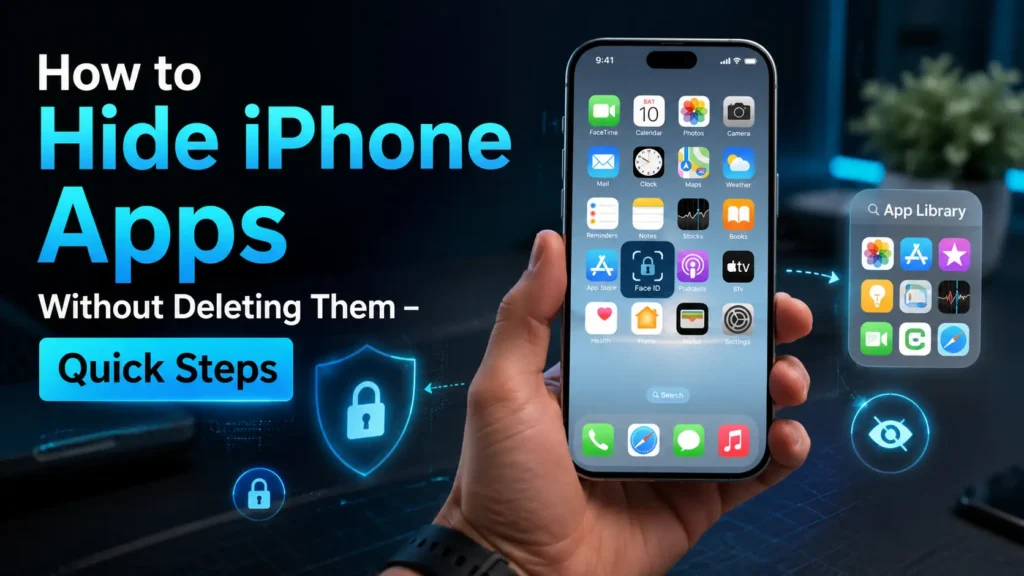
Your iPhone probably has apps you don’t want sitting in plain view all the time. It could be a banking app, a budgeting tool, work-related software, or simply apps you don’t use every day. Deleting them isn’t always the right solution because you’ll lose quick access and may need to download them again later.
Fortunately, Apple includes several built-in ways to hide apps while keeping them installed. Whether you want extra privacy, a cleaner Home Screen, or a better-organized device, you can hide apps without removing your data.
In this guide, you’ll learn how to hide iPhone apps using simple methods that work on modern versions of iOS. You’ll also learn where hidden apps go, how to open them again, and which option is best for your situation.
Quick Answer How to Hide iPhone Apps?
If you’re wondering how to hide apps on iPhone, you have several easy options without deleting the app.
You can:
- Hide an app behind Face ID, Touch ID, or your passcode.
- Remove the app from your Home Screen while keeping it installed.
- Organize apps through the App Library for a cleaner layout.
- Use Screen Time restrictions to limit access to certain apps.
All of these methods keep your apps installed, so your personal data, settings, and accounts remain available.
Quick Steps to Hide Apps on iPhone
If you only need the fastest solution, follow these steps.
Hide an App with Face ID
- Touch and hold the app icon.
- Tap Require Face ID or the available security option.
- Select Hide and Require Face ID.
- Confirm using Face ID, Touch ID, or your passcode.
The app moves into the protected Hidden section and stays installed on your iPhone.
Remove an App from the Home Screen
- Press and hold the app.
- Tap Remove App.
- Choose Remove from Home Screen.
The app disappears from your Home Screen but remains available in the App Library.
Why Hide iPhone Apps?
People choose to hide apps on iPhone for many different reasons, and privacy is only one of them.
Some prefer a cleaner Home Screen with fewer icons, while others want to keep sensitive apps away from anyone who might briefly use their phone. Parents may also want to reduce distractions or limit access to certain apps without removing them completely.
Common reasons include:
- Keeping banking or finance apps more private.
- Hiding work-related apps during personal time.
- Reducing Home Screen clutter.
- Organizing rarely used apps.
- Keeping shopping, travel, or utility apps out of sight.
- Adding an extra layer of protection to personal information.
If you’ve been asking how can I hide my apps on my iPhone, the good news is that Apple already includes these features, so you don’t usually need an app to hide apps on iPhone. Built-in tools are safer, easier to manage, and work seamlessly with your device.
Can You Hide Apps on iPhone?
Yes. One of the most common questions is can you hide apps on iPhone? The answer is yes, although the available options depend on your iPhone model and iOS version.
On newer versions of iOS, you can hide an app on iPhone by protecting it with Face ID, Touch ID, or your device passcode. Once hidden, the app is moved into a protected area that requires authentication before it can be opened.
If your device doesn’t support that feature, you can still remove apps from the Home Screen. This keeps the app installed while making your Home Screen cleaner and less crowded.
Method 1: Hide Apps Using Face ID
If your iPhone supports the latest app privacy features, this is the most secure way to hide an app without uninstalling it. Instead of simply removing the icon from your Home Screen, the app is placed in a protected Hidden folder that requires Face ID, Touch ID, or your passcode before it can be opened.
This option is ideal for apps that contain personal or sensitive information, such as banking, budgeting, health, or work-related apps.
Follow These Steps
- Touch and hold the app you want to hide.
- When the menu appears, tap Require Face ID (or Touch ID or Passcode, depending on your device).
- Choose Hide and Require Face ID.
- Confirm your identity when prompted.
After these steps, the app is removed from the Home Screen and placed in the protected Hidden section. It remains installed, and your data stays exactly as it was.
Good to know: Some built-in Apple apps cannot be hidden using this method. It is primarily available for supported downloaded apps.
Method 2: Remove Apps from the Home Screen
Not everyone wants to lock an app behind Face ID. Sometimes, all you need is a cleaner Home Screen.
Removing an app from the Home Screen keeps it installed while moving it to the App Library. This is one of the quickest ways to organize your iPhone without affecting your apps or personal data.
Here’s How
- Press and hold the app icon.
- Tap Remove App.
- Select Remove from Home Screen.
The app icon disappears from your Home Screen, but the app itself remains on your iPhone. You can still open it from the App Library whenever you need it.
This method works well if your goal is organization rather than privacy.
Method 3: Organize Apps with the App Library
The App Library automatically organizes installed apps into categories, making it easier to keep your Home Screen uncluttered.
Although you can’t completely remove the App Library, you can use it to keep less frequently used apps out of sight while still making them easy to access.
This is a practical choice for travel apps, shopping apps, utility tools, or games that you don’t open every day.
Benefits of Using the App Library
- Keeps your Home Screen tidy.
- Apps remain fully functional.
- No need to reinstall anything later.
- Makes everyday navigation simpler.
Many people confuse this with hiding the App Library itself. In reality, the App Library is designed to stay available, but it works well as a place to keep apps that don’t need to appear on your Home Screen.
Which Method Is Best?
Each option serves a different purpose. Choosing the right one depends on how much privacy or organization you want.
| Goal | Recommended Method | Best For |
|---|---|---|
| Keep sensitive apps private | Hide with Face ID | Banking, finance, work, personal apps |
| Reduce Home Screen clutter | Remove from Home Screen | Everyday organization |
| Keep rarely used apps available | App Library | Shopping, travel, utilities, games |
| Hide multiple apps at once | Hide Home Screen pages or organize with App Library | Cleaner device layout |
Which Option Should You Choose?
If your priority is privacy, hiding apps with Face ID offers the strongest protection because only you can open the hidden app after authentication.
If you’re simply trying to organize your device, removing apps from the Home Screen is usually the quickest solution. Your apps remain installed, and you can open them from the App Library whenever needed.
For many people, combining these methods creates the best experience. Frequently used apps stay on the Home Screen, private apps are protected with Face ID, and less important apps remain tucked away in the App Library.
Coming Up Next
Now that you’ve learned the most effective ways to hide apps without deleting them, the next section explains where hidden apps go, how to find and unhide them, how Screen Time restrictions work, common mistakes to avoid, and answers to the most frequently asked questions.
Method 4: Hide Entire Home Screen Pages
If you have several apps you don’t use every day, hiding an entire Home Screen page can instantly make your iPhone feel more organized. Instead of hiding apps one by one, this method lets you temporarily remove a whole page while keeping every app installed.
How to Hide a Home Screen Page
- Touch and hold an empty area of the Home Screen until the icons begin to jiggle.
- Tap the page indicator dots near the bottom of the screen.
- Uncheck the page you want to hide.
- Tap Done to save your changes.
The apps on that page won’t appear on your Home Screen, but they’ll still be available in the App Library. You can make the page visible again at any time by repeating these steps and checking it again.
This option is especially useful if you want a cleaner layout without moving dozens of apps individually.
Method 5: Use Screen Time Restrictions
Screen Time includes built-in controls that can limit access to certain apps and content. Although it was originally designed for parental controls, it can also help you reduce distractions or limit access to selected apps.
Set Up Screen Time
- Open Settings.
- Tap Screen Time.
- Turn on Content & Privacy Restrictions.
- Configure the options that fit your needs.
Depending on your settings, you can:
- Restrict certain built-in apps.
- Limit apps by age rating.
- Reduce access to selected content.
- Add a Screen Time passcode for extra protection.
Keep in mind that Screen Time restrictions are different from hiding apps with Face ID. They focus on limiting access rather than placing apps in the Hidden folder.
How to Find Hidden Apps on iPhone
One of the most common questions is how to find hidden apps on iPhone after they’ve been hidden.
If you used Face ID to hide an app:
- Open the App Library.
- Scroll to the bottom.
- Tap the Hidden folder.
- Authenticate with Face ID, Touch ID, or your passcode.
- Tap the app to open it.
If you simply removed the app from the Home Screen, open the App Library and browse to its category or use the alphabetical list to locate it.
How to Unhide Apps on iPhone
Making an app visible again only takes a few moments.
For Apps Hidden with Face ID
- Open the Hidden folder.
- Authenticate using Face ID or your passcode.
- Touch and hold the app.
- Select the option to stop hiding or requiring authentication.
For Apps Removed from the Home Screen
- Open the App Library.
- Find the app.
- Touch and hold the app icon.
- Tap Add to Home Screen if that option is available, or drag the icon back onto the Home Screen.
Common Mistakes to Avoid
Many people think hiding an app and deleting an app are the same thing, but they’re completely different.
Avoid these common mistakes:
- Choosing Delete App when you only want to remove it from the Home Screen.
- Assuming the App Library can be turned off completely.
- Forgetting your Screen Time passcode after enabling restrictions.
- Expecting every built-in Apple app to support Face ID hiding.
- Thinking hidden apps lose their data—they don’t.
If you’re troubleshooting a more serious issue with your iPhone, hiding or removing apps may not be enough. In those situations, you may need to factory reset your iPhone without a password to restore access or prepare the device for a fresh start.
Understanding these differences helps you choose the right method without accidentally removing important information.
Tips for Better Privacy
If privacy is your main goal, hiding apps is only one part of protecting your iPhone.
You can also:
- Lock your iPhone with a strong passcode.
- Keep Face ID or Touch ID enabled.
- Review app permissions regularly.
- Disable unnecessary notifications on the Lock Screen.
- Keep iOS updated to receive the latest security improvements.
Together, these habits make it much harder for someone else to access your personal information. If you’re improving your iPhone privacy, you may also find our guide on how to find deleted messages on iPhone helpful for recovering accidentally removed conversations.
Frequently Asked Questions
Can you hide apps on iPhone without deleting them?
Yes. You can hide apps while keeping them installed by using Face ID on supported iOS versions or by removing them from the Home Screen so they remain available in the App Library.
How do I hide an app on my iPhone?
Touch and hold the app icon and choose the available hiding or security option if your device supports it. Otherwise, remove the app from the Home Screen to keep it installed but out of sight.
Where do hidden apps go?
Apps hidden with Face ID move to the Hidden section inside the App Library. Apps removed from the Home Screen remain in the App Library under their normal category.
Can I hide the App Library?
No. The App Library is a permanent part of modern iOS. While you can’t remove it, you can use it to keep your Home Screen cleaner by storing less frequently used apps there.
Does hiding an app delete my data?
No. Hiding an app doesn’t remove your account, settings, documents, or other saved information. Everything remains on your device unless you choose to delete the app.
Can I hide built-in Apple apps?
Some built-in apps can be removed from the Home Screen, but not every built-in app supports the Face ID hiding feature. Available options depend on the app and your iOS version.
Final Thoughts
Learning how to hide iPhone apps without deleting them is an easy way to improve both privacy and organization. Whether you want to protect personal apps, reduce Home Screen clutter, or keep less frequently used apps out of sight, iPhone offers several built-in options that don’t require uninstalling anything.
For the highest level of privacy, use Face ID to hide supported apps behind authentication. If your goal is simply creating a cleaner Home Screen, removing apps from the Home Screen and relying on the App Library is a quick and effective solution.
Choose the method that fits your needs, and remember that your apps, settings, and data remain safely on your device. With just a few taps, you can create a more organized iPhone while keeping important apps available whenever you need them.
Keeping your iPhone organized also means protecting important memories and files. If you’ve accidentally removed pictures, our guide on how to recover deleted photos on iPhone explains the fastest ways to restore deleted photos using Apple’s built-in recovery options.